Tag Archive for: Public Integrity Unit

DA Weekly News with DA Summer Stephan 02-19-26: Ex-Convict Charged with Misusing Public Funds

In this week’s DA news, DA Summer Stephan discusses the felony charges against a former nonprofit executive accused of misappropriating more than $130,000 in County opioid settlement funds. The case highlights the importance of transparency, oversight, and protecting taxpayer dollars. If you suspect misuse of public funds, you can report concerns to the DA’s Public Integrity Unit through the San Diego County District Attorney’s Office website. The District Attorney’s Public Integrity Unit investigates and prosecutes cases involving elected or appointed public officials, government employees committing crimes on the job, misuse of public funds or resources, fraud on the court and attorney misconduct. County employees or the public can submit a complaint on our website: https://www.sdcda.org/preventing/public-integrity/ or by emailing DA Public Integrity Unit at SDDAPublicIntegrity@sandiegoda.gov.

Ex-Convict with Record of Embezzlement Charged with Misappropriation of Public Money for Using County Consumer Opioid Settlement Grant Funds for Plastic Surgery, Vacations, and Personal Expenses

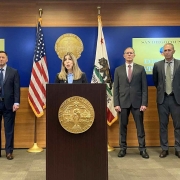
San Diego County District Attorney Summer Stephan announced charges today against a woman who was previously convicted of stealing over $500,000 from her employer. Her latest scheme involved bilking San Diego County out of more than $130,000 to fund her lavish lifestyle including two cosmetic plastic surgeries, luxury vacations, SDG&E bills for her personal homes, home improvement, and martial arts training. [WATCH THE NEWS CONFERENCE HERE]

Amy J. Knox, 45, has been charged with three felony counts of misappropriating public money and three felony counts of embezzlement with the white-collar fraud allegation for great taking from the over $4 million consumer protection monies awarded by San Diego County to the nonprofit organization Harm Reduction-SD. The funds were part of the over $50 billion secured by The California Attorney General as part of nationwide settlements and bankruptcy agreements from corporations implicated in the opioid epidemic. These consumer funds obtained from opioid settlements, were intended to increase prevention and treatment and reduce fentanyl deaths in the County.

“This defendant had a history of stealing large amounts of money from her employer and violating their trust, yet she was still able to be in charge of millions of dollars in public funds,” DA Stephan said. “Checks and balances exist for a reason, yet there was no evidence of a background check. Even after professional county staff raised concerns, County officials awarded a second contract to Harm Reduction-SD, allowing this defendant to line her pockets with public funds.”

From July 2022 to June 2025, Knox served in the chief operating officer role for Harm Reduction-SD. She controlled the nonprofit’s finances and was designated as the contract administrator for the County contracts, serving as the main liaison between Harm Reduction-SD and County contracting officials. Knox was responsible for oversight of the naloxone distribution, managing payroll, tax filings, vendor contracting, and supplies management.

Harm Reduction-SD received $4.2 million from the County’s Health and Human Services Agency, Behavioral Health Services Department. The first contract in July 2022 was for Naloxone distribution. The second contract in August 2024 was for drug checking. This service was to check for the presence of fentanyl in illegal street drugs that community members in homeless encampments planned to ingest.

In January 2023, a concerned citizen alerted the County that Harm Reduction-SD CEO, Tara Stamos, was storing Narcan (opioid overdose reversal medication) under a tarp in her East County front yard in 100-degree weather. In April 2023, a financial audit completed by the county’s professional employees uncovered significant financial control weaknesses, including insufficient bank reconciliations and a deficient general ledger.

The County then discovered that Knox had previous embezzlement convictions. Less than a year later in August 2024, Harm Reduction-SD was awarded the second contract.

During her embezzlement of public funds, Knox made thousands of purchases for personal items and services on at least four personal credit cards. From January 2024 to May 2025, she used Harm Reduction-SD’s checking account to pay off her monthly credit card balances via electronic bank transfers. Her personal expenses on these cards included trips to Hawaii and Disneyland, high end women’s clothing and cosmetics, various streaming service subscriptions, home improvement expenses, purebred dogs and dog training, and martial arts training. The total amount was more than $90,000.

In addition to paying off her credit cards, from October 2023 to May 2025, Knox embezzled over $10,000 in public funds to pay the SDG&E bills on two of her residential properties. She also used embezzled public funds to pay for $30,000 worth of full body cosmetic surgery.

Knox’s fraud came to light when she began to accuse Harm Reduction-SD’s CEO, Tara Stamos of malfeasance. Stamos responded by reporting to the District Attorney’s Office that she had discovered unauthorized transactions by Knox. The DA’s Special Operations Division, which has a premier Public Integrity Unit, began the investigation that resulted in these charges. The investigation is ongoing to determine how this malfeasance occurred, why it was allowed to continue and to prevent it from happening again.

The County terminated both Harm Reduction-SD contracts in June 2025.

“When the county terminated the contract, there was no referral for criminal investigation to the DA’s Public Corruption Unit, as has been done by Board leadership in prior instances of suspected malfeasance,” DA Stephan said. “Consumer protection funds are public dollars that should be safeguarded. They are the public’s funds that must be treated with transparency and accountability.”

If any County employees in charge of public funds have information about suspected malfeasance, they should feel comfortable coming forward to report their concerns to the District Attorney’s Office. Under whistleblower laws, they will be protected.

“Whistleblowing is an important part of public safety,” DA Stephan said. “It is often the first line of defense against corruption and misuse of public funds.”

The District Attorney’s Public Integrity Unit investigates and prosecutes cases involving elected or appointed public officials, government employees committing crimes on the job, misuse of public funds or resources, fraud on the court and attorney misconduct. County employees or the public can submit a complaint on our website: https://www.sdcda.org/preventing/public-integrity/ or by emailing DA Public Integrity Unit at SDDAPublicIntegrity@sandiegoda.gov.

Deputy District Attorney Matthew Dix is prosecuting this case, and DA Investigator Mark Kelley conducted the investigation.

Knox was arraigned today and pleaded not guilty. Her bail was set at $200,000 and a bail review hearing is set for February 25 at 8:30 a.m. in Department 101. A readiness hearing is set for April 1 at 8:15 a.m. in Department 1102. [WATCH THE NEWS CONFERENCE HERE]


NEWS CONFERENCE: DA Charges Woman with Embezzling Public Opioid Funds for Luxury Lifestyle

DA Summer Stephan announces charges against a woman who bilked San Diego County out of more than $130,000 to fund her lavish lifestyle including plastic surgery and luxury vacations. The defendant, Amy J. Knox, was previously convicted of stealing over $500,000 from her employer.

Former Chula Vista City Councilmember Andrea Cardenas Sentenced on Grand Theft Charges

San Diego County District Attorney Summer Stephan said today that defendant Andrea Cardenas, 32, a former Chula Vista City Councilmember, was sentenced on August 28 to two years of formal probation for committing two felony counts of grand theft. She was also ordered to complete 100 hours of volunteer work. The Probation Department and the District Attorney’s Office requested she serve 180 days in county jail, but she was ultimately sentenced to credit for time served of one day custody.

“Our dedicated prosecution team conducted a thorough investigation in which they served 27 search warrants to examine financial and email accounts,” DA Stephan said. “The investigation proved that Cardenas had engaged in multiple fraud schemes over several years. In these types of cases, we often rely on the public, the media, or people who suspect wrongdoing to report potential public integrity crimes to our office so we can investigate.”

Should Cardenas violate the terms of her probation, she could be ordered to serve up to two years and eight months in jail. Cardenas pleaded guilty to fraud, related to funds obtained from the federal Paycheck Protection Program and the state Employment Development Department. Cardenas cheated the U.S. government out of $176,000 in COVID-19 relief funds, which she laundered and used to pay for personal expenses such as her own campaign debt. She also unlawfully applied for over $28,000 in unemployment benefits. 

Superior Court Judge Rachel Cano ordered that Cardenas’ terms of probation also include that she submits to search and seizure, must operate any business legally and comply with all rules and regulations of such business including being licensed, paying taxes, and comply with any campaign finance laws. She must also pay back the full amount she stole including $176,227 to the Small Business Administration, $28,908 to the Employment Development Department, and an amount to be determined to the Franchise Tax Board.

Cardenas worked for a political consulting firm called Grassroots Resources, started in 2016 by her brother, Jesus Cardenas. She had the title of Director of Community Engagement, but really held a role as Chief Operating Officer. In 2019, Grassroots Resources began acting as a payroll service for one of their clients, Harbor Collective, a marijuana dispensary. In early 2021, Grassroots Resources was being pressured to pay off debts including money owed to TMC Direct, a political mailing company.

In February 2021, Jesus and Andrea Cardenas filed for a Paycheck Protection Program (PPP) Loan from the Small Business Administration via PayPal. They misrepresented multiple items on the application, including: that Grassroots had 34 employees, when in reality 30 of these individuals worked for Harbor Collective; that they were not engaged in activity illegal under federal law (marijuana dispensaries are not legal under federal law); that they were not a business engaged in political consulting; and that the loan funds would be used to cover payroll expenses. The loan was approved for $176,227. 

On May 3, 2021, $176,227 of PPP loan funds were deposited into a Grassroots’ business account. Over the course of the next two weeks, the money was transferred between two different Grassroots accounts. From there, the Cardenas siblings used the PPP funds to pay off multiple personal expenses including campaign debt.

In a separate fraud scheme in 2020, Cardenas unlawfully applied for unemployment benefits and received $28,908 from the Employment Development Department. She misrepresented on applications that she was not working and not receiving any income. However, Grassroots Resources, for which she was working, was fully operational during that election year handling the campaigns of multiple candidates and other entities.

This case was prosecuted by the San Diego County District Attorney’s Office Public Integrity Unit. Team members included Deputy District Attorneys Chandelle Boyce, Hector Jimenez, Leon Schorr, District Attorney Investigators James Hawksley, Justin Bostic, and Forensic Accountant Kevin Boyne. The investigation was also aided by the Department of Homeland Security Covid Fraud Unit. 

“Our office remains committed to prosecuting cases involving misuse of public funds, political corruption, and criminal misconduct of government officials,” DA Stephan said. “The goals of these prosecutions are not solely to obtain the maximum time in custody but often include other goals like making sure that individuals who engage in corruption are not in public office and can’t seek public office in the future, as an example.”