Tag Archive for: San Diego County Office of Education

Stolen Funds Coming Back to Support Students

San Diego County District Attorney Summer Stephan announced the San Diego County Board of Supervisors has given her office authority to grant $25 million from the Charter School Fraud trust fund to the San Diego County Office of Education (SDCOE) to fund a seven-year, countywide plan to strengthen and expand access to mental health, safety, wellness, and educational supports for K-12 students and their families. The community-responsive plan focuses on the unique strengths and needs of each region in order to connect needed resources to students experiencing homelessness and other youth who can thrive with additional support. The Board approved the grant at their January 28 meeting.

WARCH COMPLETE NEWS CONFERENCE, HERE.

“This funding will make a real difference in the lives of K-12 students and their families as they navigate wellness, safety, homelessness and mental health challenges,” said DA Stephan. “I continue to be very proud of our public corruption/consumer protection expert prosecution team that delivered justice in the A3 Charter Schools criminal case and now, we’re seeing how the trust fund established as a result of the case is impacting the community in positive ways, funneling the money stolen by the defendants back to deserving young people in our schools.”

Funds for the grant originate from criminal fines imposed in the landmark A3 Charter Schools fraud case which was prosecuted by the San Diego County District Attorney’s Office. In all, more than $280 million in stolen funds were recovered. The judge who oversaw the case ordered a portion of the fines to be paid to the County of San Diego now, a portion to be paid to victims in kindergarten through 12th grade, and a portion to be paid to the state of California.

Under a resolution passed unanimously by the San Diego County Board of Supervisors in 2021, the fines imposed by the court related to this case were earmarked and exclusively dedicated to programs that directly serve the needs of kindergarten through 12th grade students in San Diego County. The funds are not intended for County operational programs, but rather to support community-serving, education-focused initiatives, consistent with the court’s intent. After disbursement of the $25 million grant, the Charter School Fraud trust fund will have $5 million remaining in it. Superior Court Judge Fred Link who masterfully presided over the criminal case issued clear guidance regarding the monies recovered and this meets the direction by the court.

The Board’s recommendation authorizes the District Attorney’s Office to continue administering its Community Grant Program (CGP) and award the one-time $25 million grant to SDCOE to implement the HeartSpire initiative, a seven-year, countywide plan. This action builds on prior Board approvals related to the CGP and the Charter School Fraud trust fund. The $25 million is actually an aggregate of several $2.2 million to $3.8 million grants each over seven school years.

The SDCOE HeartSpire initiative is designed to connect and amplify the work happening at school sites and in county services across all five supervisorial districts. Consistent with prior K-12 grant actions, the focus is on equitable access and regional coverage, rather than limiting investments to a single geographic area.

“We are grateful the DA has entrusted SDCOE with this opportunity to build upon our efforts to positively impact students, families, and communities throughout the county,” said Dr. Gloria E. Ciriza, San Diego County superintendent of schools. “HeartSpire is rooted in the belief that human connection, mental health, and relational infrastructure are essential to thriving educational systems. Accordingly, this grant will align the DA’s Office, schools, County Health and Human Services, and community-based organizations to offer integrated services that make a real difference for students and families.”

Following establishment of the trust fund, a multi-department stakeholder workgroup with representatives from the District Attorney’s Office, Behavioral Health Services, County Office of Equity & Racial Justice, and Department of Child & Family Well-Being reviewed options for use of the funds. Based on those discussions, an initial phase of 47 K-12 community grants totaling approximately $6.4 million was awarded in 2022. Those grants supported literacy, tutoring, mentoring, youth leadership, and mental health and wellness services. The initial grant activity informed subsequent consideration of opportunities for a more coordinated, regional approach, leading to the SDCOE HeartSpire proposal.

The County’s existing stakeholder workgroup will have opportunities to review program progress, milestones, and updates as implementation proceeds, particularly in advance of future funding periods within the seven-year plan.

The DA’s Community Grant Program (CGP) originated from early crime-reduction and prevention efforts and was later expanded by the Board to include education- and prevention-focused K–12 initiatives, including grants funded through the Charter School Fraud trust fund. The HeartSpire proposal represents a continuation of that evolution, while maintaining the CGP’s core purpose of supporting community-based solutions that promote safety, wellness, and opportunity.
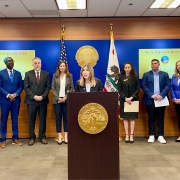
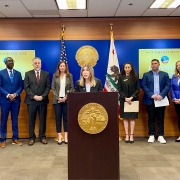
NEWS CONFERENCE: $25 Million in Stolen Funds Returned to Support San Diego Students

After successfully prosecuting the landmark A3 Charter Schools fraud case, the San Diego County District Attorney’s Office recovered more than $280 million in stolen education funds. In sentencing, the judge ordered that the recovered money be distributed to benefit the public—directing portions to the County of San Diego, to K–12 student victims, and to the State of California—and made clear that funds designated for students must be used exclusively for programs that directly support K–12 education.

As a result, a Charter School Fraud Trust Fund was established, and the DA’s Office was authorized by the County Board of Supervisors to administer grants that return stolen dollars to students and families. The DA’s Office has now awarded $25 million from that trust fund to the San Diego County Office of Education (SDCOE) to implement HeartSpire, a seven-year, countywide initiative that brings together schools, county services, and community partners to expand mental health, safety, wellness, and educational supports for K–12 students across San Diego County—turning accountability into real, lasting impact.

Schools Embracing Drug Prevention Programs

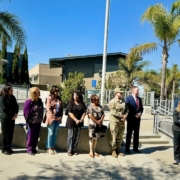
San Diego County District Attorney Summer Stephan joined law enforcement leaders, school officials and the California National Guard today to announce the release of a new report outlining recommendations for drug prevention education and anti-overdose efforts in schools. Nearly two dozen schools across San Diego County are already adopting and implementing recommendations from the working group that produced the report which includes five drug abuse prevention and three drug overdose prevention programs.

School-based Interventions for Substance Use and Overdose Prevention lays a foundation for programs in a school setting that can deter or delay the onset of substance use, slow or stop the progression of use and development of substance use disorders and minimize the adverse impact of substance use on students, their families and community, and the economy.

“It’s critical that we educate our youth through compelling and effective curriculum, giving them the tools they need to stay healthy and make decisions that can literally save their lives,” said DA Stephan. “I want to thank the San Diego County Board of Supervisors for their commitment to this issue, the working group that was assembled for the careful consideration they gave to creating this report, and school officials for embracing the drug prevention programs that can make a real difference in the lives of families across San Diego County.”

In October 2022, the San Diego County Board of Supervisors unanimously approved a proposal backed by the County Office of Education to support fentanyl education in county schools, as well as the distribution of naloxone to parents and students and training on its use. The DA assembled a working group of experts that included representatives from the San Diego County District Attorney’s Office, San Diego County Office of Education (SDCOE), San Diego and Imperial Valley High Intensity Drug Trafficking Area (HIDTA), and California National Guard Counterdrug Task Force.

The goal of working group was to study and make recommendations regarding the most effective and proven modalities and programs for building long term resilience in students to live healthy lives free of the negative, and at times, fatal impact of drugs including fentanyl.

“While the HIDTA program is charged with removing deadly drugs from our streets in part by dismantling and disrupting drug trafficking and money laundering organizations, we know that if we are going to be effective in saving the lives of the most vulnerable among us, our youth, then our efforts must include effective, proven life skills and drug prevention curriculum within our schools,” said HIDTA Director David King. “The San Diego Imperial Valley HIDTA is proud to have contributed to the efforts of the working group to identify such curricula and it’s partnerships such as these that make San Diego County a model for the rest of the country.”

“The San Diego County Office of Education has long been a proponent of substance abuse prevention education that incorporates life skills, healthy behaviors, and overall wellness because it’s the right thing for kids,” said Dr. Gloria E. Ciriza, County Superintendent of Schools. “We are fortunate to have strong partnerships with county leaders, law enforcement agencies, and community-based organizations that bring research-validated programs to support our region’s children in staying healthy and safe.”

Fatal overdoses involving fentanyl have surged in recent years in the United States and research shows that deaths among children have increased significantly, mirroring trends among adults. Fentanyl, which is 100 times stronger than morphine, is now present in nearly all illegal substances used by teens. Older adolescent fentanyl poisonings are primarily the result of counterfeit pills containing a lethal dose of fentanyl.

The report found that preventing youth substance use is multifaceted and requires a comprehensive community prevention strategy comprised of synthesized programs, practices, and policies grounded in the best available evidence for greatest impact within individuals, families, schools, and communities. When individuals initiate alcohol and drug use during adolescence, they are much more likely to develop a substance use disorder as a young adult and beyond. Evidence has shown that youth who begin drinking before age 15, for example, experience four to six times the rate of lifetime alcohol dependence than those who remain abstinent from alcohol use until age 21.

Decades of research has shown that much can be achieved through primary prevention interventions delivered during childhood and adolescence to reduce an individual’s later risk for drug use disorders. The report notes that prevention efforts must be initiated in early adolescence and should be targeted towards preventing the use of common substances that are legal for adults but remain illegal for adolescents such as alcohol, nicotine, and marijuana. These substances are often referred to as gateway drugs and may lead to the use of methamphetamine, cocaine, heroin, or opioids that may also contain fentanyl.

Based on the data and research reviewed by the working group, two specific goals were identified:

  • Prevent initiation or escalation of substance use in youth 18 and under through evidence-based substance use prevention curricula in schools.
  • Prevent overdoses in youth 18 and under using the best available evidence.

It was important for the working group to consider a variety of curriculum options due to the differences in school schedules, structures, and cultures. After careful review of the evidence listed in a variety of registry databases of available programs, and consultation with experts in curriculum analysis and prevention science, five effective drug abuse prevention programs were identified for elementary, middle, and high school populations: Positive Action, Project Towards No Drug Abuse, LifeSkills Training, DARE’s Keepin’ It Real, and Project Alert.

Students at Vista del Mar Middle School participate in one of the programs identified in the report: Rugged Outdoor Physical Experience System (R.O.P.E.S.) is a drug prevention program that focuses on communication and team building to help young people determine when to ask for help and how to receive it.

Students at Vista del Mar Middle School participate in one of the programs identified in the report: Rugged Outdoor Physical Experience System (R.O.P.E.S.) is a drug prevention program that focuses on communication and team building to help young people determine when to ask for help and how to receive it.

Many of the curricula outlined in the report are being taught in participating schools by members of the California National Guard Counterdrug Task Force. The National Guard is also committed to assisting schools that opt to have prevention curricula taught by their own teachers by providing training, free of charge, on the implementation and teaching of the identified curricula.  SDCOE, with funding from the County of San Diego’s Opioid Settlement Funds, is also working with middle schools in the county to implement Project Alert, one of the research-validated programs highlighted in the report.

After careful review, the working group also identified three programs that show real promise in addressing the goal of overdose prevention:

  • Operation Prevention San Diego. This Drug Enforcement Administration program is a free educational program available to schools upon request or at Operationprevention.com.
  • “I Choose My Future” is a drug education program offered to schools by the San Diego County Office of Education.
  • The working group is also recommending that all schools serving grades 6 through 12 obtain an adequate supply of naloxone.

Schools and organizations that have embraced educational programs recommended by the report include Mar Vista High School, Mar Vista Academy, Sweetwater High School, Barbara Worth Jr. High School, Vista Del Mar Middle School, San Ysidro Middle School, La Mirada Elementary School, Olympian High School, Saburo Murakoa Elementary School, All Tribes Charter School, Southwest High School, Maie Ellis Elementary School, La Paloma Elementary School, Mission Meadows Elementary School, Oceanside High School, Valle Lindo Elementary School, San Pasqual Academy, Smythe Elementary School, The Rock Academy,  Ocean View Hills Elementary School, Vista Boys & Girls Club, and Imperial Beach Boys & Girls Club.

The release of the report comes as Red Ribbon Week is about to be observed next week. The DA pointed to the important awareness that Red Ribbon Week brings to drug prevention, which was started to honor murdered DEA Agent Enrique ‘Kiki” Camarena here in San Diego and grew into a national movement. In addition, officials acknowledged the efforts of the County Office of Education under the leadership of former School Superintendent Paul Gothold, as well as the work done in the drug abuse prevention space by retired DEA Agent Rocky Herron.

The full report, School-based Interventions for Substance Use and Overdose Prevention, can be found here.

DA Provides New Resource to Help Prevent School Violence

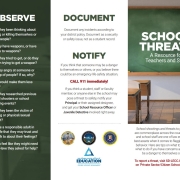
San Diego County District Attorney Summer Stephan announced a new resource to help teachers spot red flags that could potentially lead to school violence, including school shootings. In partnership with the San Diego County Office of Education, the FBI and the San Diego Law Enforcement Coordination Center, the District Attorney’s Office produced a web and print-ready brochure that offers tips on what school employees should look for and what to do if they are concerned a student may be a danger to themselves or others.

“Preventing school shootings and keeping our kids and schools safe, often depends on teachers, staff, students and the community reporting concerning behavior to law enforcement,” DA Stephan said. “In San Diego County, we have a protocol that allows us to promptly respond to threats and neutralize them. This new brochure will provide school staff a quick guide on what to look for and how to report it.”

Tips in the brochure, called School Threats: A Resource for Teachers and Staff include how to observe, document and notify when a student may be emulating the behavior of previous school shooters. The resource offers information about what type of written material and social media posts are common among individuals who engage in mass violence.

“Ensuring the safety and well-being of students and staff members while on a school campus is integral to student success,” said San Diego County Superintendent of Schools Dr. Paul Gothold. “We are thankful to DA Stephan and the FBI for their continued collaboration on supports and interventions that reduce the threat of violence at our schools.”

Since 2018, the District Attorney’s Office has been working to stop those who might carry out threats before they can act, through the School Threats Protocol, which encompasses all 42 school districts in the County. The protocol guides how schools, law enforcement and prosecutors respond to school threats, using evidenced-based guidelines for investigation and resolution of the threat.

The most important revelation from our work in this area is the importance the public plays in warning law enforcement of threats that are made to do harm, no matter how insignificant they may seem.

Last year, the District Attorney’s Office reviewed 48 reports of school threats and filed criminal charges in 10 of those cases. So far this year, there have been 33 cases submitted for review with eight cases being charged. Even when the evidence does not support filing criminal charges, a variety of mental health and other supportive systems are engaged to enhance safety.

“FBI San Diego is committed to supporting our communities in the effort to prevent targeted violence in schools,” said Stacey Moy, Special Agent-in-Charge. “This reporting tool is an important part of our community effort to foster an educational environment wherein school faculty and staff recognize behaviors that are objectively concerning, understand how and where to report them, and feel confident that their reports will be taken seriously and followed up on. FBI is pleased to participate in this effort.”

When the District Attorney’s Office receives a school threats case for review, multiple factors are evaluated to confirm the credibility of a threat once the suspect has been identified, including:

  • Investigate their background, including whether the person made prior threats
  • Look at open-source intelligence such as social media posts
  • Check to see if they have registered guns, have made recent ammunition purchases, or have access to guns
  • Check on whether there has been contact with terrorist organizations
  • Determine whether they have had psychiatric holds or other mental health red flags
  • Research whether the person has had a recent traumatic event or grievance with a particular school or person associated with a school

“The San Diego Law Enforcement Coordination Center supports and prioritizes the whole community approach with our local enforcement, District Attorney investigators, the FBI and the Educational sector to prevent any school threat,” said Leslie Gardner, Director of the San Diego Law Enforcement Coordination Center. “We are committed to this ongoing effort and the School Safety Brochure is a valuable resource and guide for teachers and staff members to identify suspicious behavior and know how to report such information.”

Students can also interrupt school violence by reporting anonymously at StudentsSpeakingOut.org.