DA Calls on Legislature to Fix the Mental Health Diversion System by Supporting Assembly Bill 46
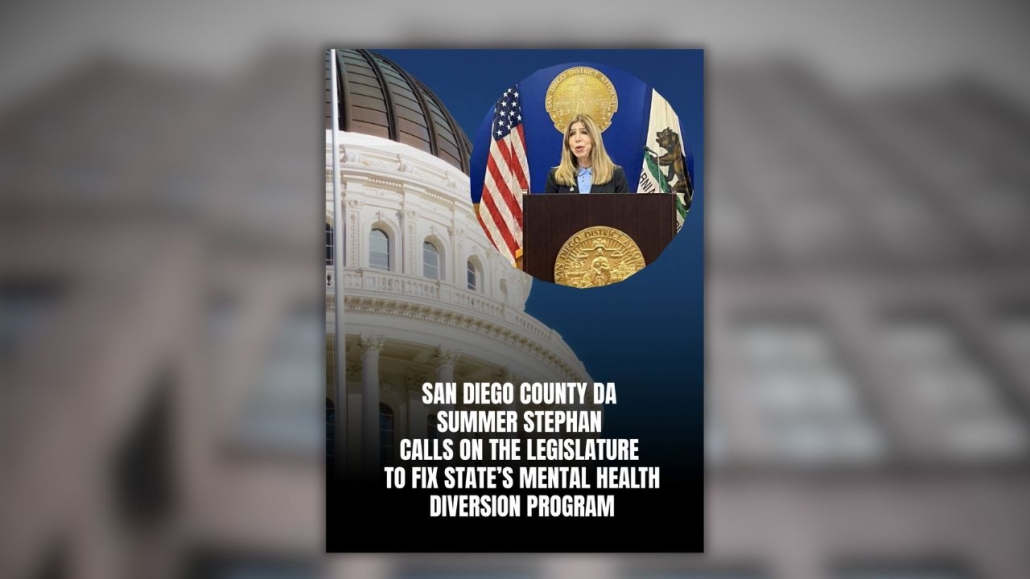
San Diego County District Attorney Summer Stephan is joining the California District Attorneys Association in their statewide call for the California Legislature to pass common sense mental health diversion (MHD) legislation, Assembly Bill 46. This legislation is sponsored by the Sacramento County District Attorney’s Office, and co-sponsored by many district attorneys’ offices across the state, including the San Diego County District Attorney’s Office. The bill closes legal loopholes in California’s mental health diversion law by restoring judicial discretion and ensuring the program provides treatment while protecting community safety.
Across California, reports have shown tragic cases in which dangerous individuals were granted mental health diversion only to commit violent crimes later – including murder, attempted murder, domestic violence and more. The following are three case examples in San Diego County, where the defendants should not have been in a position to victimize individuals but were on mental health diversion and then committed violent acts:
- Downtown San Diego –Grant Parker, 34, stabbed and killed a victim outside of a hotel in downtown San Diego while on mental health diversion for threatening to kill his mother with a knife, carjacking and attacking a cellmate. The defendant was later involved in a self-inflicted hanging incident.
- La Jolla and Bay Park -Ty Nadelen, 20, committed a series of hot prowl residential burglaries in La Jolla using stolen vehicles and was granted mental health diversion. While on mental health diversion, he attacked his grandmother with a hammer in Bay Park.
- Vista and North Park – Priscilla Loza, 46,was on two grants of mental health diversion for carjacking in Vista and vehicle theft when she attacked a 70-year-old man in a vehicle with a wooden board in North Park.
Mental health diversion, created under Penal Code §1001.36, was designed to help individuals suffering from mental illness receive treatment instead of incarceration. However, recent court rulings and statutory limitations have significantly restricted judges’ ability to deny diversion – even in serious and violent cases – leaving courts with limited authority to evaluate whether diversion is truly appropriate.
“Mental health diversion was created to provide treatment for individuals whose crimes are driven by mental illness, but it was never intended to put victims and communities at risk,” said San Diego County District Attorney Summer Stephan. “Unfortunately, gaps in the current law have removed the ability of judges to use their discretion in cases where diversion is clearly not appropriate. Assembly Bill 46 restores common-sense safeguards so courts can ensure that treatment is provided to those who truly need it, while protecting public safety and preventing dangerous outcomes.”
Under current law, once a defendant meets certain statutory criteria, judges have very limited discretion to deny diversion. Courts have even been forced to approve diversion in cases where no clear treatment plan exists, community safety is at risk, or where defendants have failed prior treatment efforts – due to how the statute is written and interpreted by appellate courts.
Further, once a defendant completes Mental Health Diversion, the crime is removed from the defendant’s criminal history, removing accountability for dangerous crimes as if the crime was never committed. This puts victims, law enforcement and communities at risk if the program is not implemented properly.
AB 46 addresses these concerns by allowing courts to consider whether a defendant poses a substantial and undue risk to the physical safety of another person and whether the proposed treatment plan is clinically appropriate to address the mental health condition that contributed to the crime.
AB 46 will be heard in the Senate Public Safety Committee on March 17. Members of the public can watch the hearing live at 8:30 a.m. at: https://spsf.senate.ca.gov/committeehome
Read the CDAA letter of support here. For more information about the mental health diversion loophole visit www.placer.ca.gov/MHD.

